Edie the Chicken Needs You to VOTE If You Can

Edie is a new companion for Julia. You can see Julia’s work and occasional Edie updates @JuliaEdithRigby.
INTENTIONS | 10.1.2020
Dear Herders,
How are you doing today, actually? Are you drinking water, resting when you can, and seeking action to what troubles you?
I think this issue of The Herd speaks for itself. Huge thank you to artist Zeina Baltagi for the interview, below, and the way her art speaks to identities and public safety as related to race, gender, able-ness, mobility, and more. We also have our monthly writing prompt, a call for your work submitted by October 15th, and our list of 10 happenings coming up.
Sending you all a deep breath, a moment to pause, a bit of reflection, and of course, some time to write.
-Allie
P.S. Thank you for taking your time to read The Herd. I look forward to building this community with you, and I am also always open to feedback as this space continues to evolve and grow.
CREATIVITY CRUSH | 10.1.20
Zeina Baltagi on body politics and art as connection to the world.
Zeina Baltagi is an artist and educator based out of Los Angeles. She was born in Stockton, and raised between California and Lebanon. Throughout her work, Zeina “explores and exposes tensions within identity and social politics. The work reveals intimate transformations in relation to lived experiences with physical, emotional, economic and cultural mobility.”
We are so grateful for the time Zeina took to make this article happen. Enjoy, leave a comment, and scroll to the end for her upcoming residency and virtual events!
The Herd: How does identity and social politics influence your art, and vise-versa, if applicable?
Zeina Baltagi: Identity and social politics result in tangible consequences. Since it affects me and communities I live in; it will always affect the work and how the work is viewed.
The Herd: Can you tell us a little bit about your personal process of making art?
Zeina Baltagi: I make art to try and make sense of my existence within community. It sounds existential but it’s simple, what is my purpose here, what space do I take up on Earth? I’m constantly asking myself that question. I make art because if I don’t, I feel completely disconnected from the world. I use art to make sense of my surroundings and myself with in communities, as I try to engage with it.
The work is based on community because that’s where I spend the majority of my life. There is much diversity in the community of space that I am a part of and feel myself visible within. I suppose it’s to have purpose and be purposeful.

Baltagi’s “Daphne” in activation, materials: concrete, rebar and sand.
It is important for me to be a healthy member of those different cultures. This is not based on race or personal identity. But literally people around me. My neighbor, the owner boss woman of Posh Bagel and the employees at Loop Cafe the little expresso machine inside a Shell station’s convenience store. That is my current community.
I also think inwardly, I wonder how I could move my own culture forward, but within that there’s so much that happens, so much to challenge with side effects of colonization, war, and assimilation. There is so much work to do in our own cultural communities. Sexism, ageism, racism, homophobia are just a few things we can work on with our own familial communities that would benefit how we engage in the larger community.
I find the materials. I don’t really seek them as much as I discover them when my eyes are most open, when I’m actually observing the world around me while walking.

Zeina Baltagi’s drooping and heavy installation, “A Penny for Your Thoughts.”
Like the pennies. They’re often found on sidewalks. Art life for me is not dumpster diving for found objects. I’m not going around thrift stores and trying to look for them. I love work that does that, but this is not that. Sometimes I purchase the materials, but they are for joinery needs. I look for material that has connected interlocking memories and future histories.
I see the material for more than its surface, but for everything that it carries. I think about material in the way that one would think about their body. It really excites me when I find a material that has so much memory in it. It’s like our bodies, which have scars, memories, all these experiences inside of our bodies coming in contact with machines, things, environment and other bodies. Public objects have potential experiences of future bodies coming in contact with it. Like the penny, a sidewalk, a mobility device or a rubber tire. So, there is a moment that happens, when I realized the material, I am carrying is more than what the material is. There are exponentials to everything.
The Herd: You talk a lot about body politics, especially in your recent work Sidewalk and Daphne, using the medium of cement. What inspired these pieces?
Zeina Baltagi: The term body politics refers to the practices and policies through which powers of society regulate the human body, as well as the struggle over the degree of individual and social control of the body. The powers at play in body politics include institutional power expressed in government and laws, disciplinary power exacted in economic production, discretionary power exercised in consumption, and personal power negotiated in intimate relations. Individuals and movements engage in body politics when they seek to alleviate the oppressive effects of institutional and interpersonal power on those whose bodies are marked as inferior or who are denied rights to control their own bodies. –Pulled from the Encyclopedia.
I am always thinking of my work as coming from the perspective of myself the individual standing in place and is moving through space and how it encounters other individuals, objects and concepts. I have used my body in relation to so many aspects of body politics, at some point I realized that it was all in the sidewalk.

“
The sidewalk is where the intersections of race, culture, sex, gender, age all come together in a delineated shared space dictating how and where we navigate our bodies on earth. It felt like it embodied everything I think about.” —Zeina Baltagi
Photo on left: Baltagi’s “I’m Spinning.”
The sidewalk is where the intersections of race, culture, sex, gender, age all come together in a delineated shared space dictating how and where we navigate our bodies on earth. It felt like it embodied everything I think about. I wanted to narrow the sidewalk down even further, discussing one section of the sidewalk at a time. I decided on a racialized and gendered study of the cul-de-sac. It felt to be a heavily violent space to start from as it is the most idealized American dream for cis-white flight and assimilation into the illusive safety of whiteness.
The Herd: Are there any other artists whose work you'd like to give a shout-out to right now?
Zeina Baltagi: Yes!!! I absolutely love the artwork of Kimberly Morris you can read about her work here. As well as the artwork of Brenda Gonzalez.
The Herd: Any other questions/comments/topics you'd like to share about?
Zeina Baltagi: Everyone should read the Breathe Act as November elections are fast approaching and follow the Movement for Black Lives.
I also have a residency coming up from November 1st to December 20th accompanied with a lecture series. My project research is based around ideas of surveillance. Please follow 11:11 A Creative Collective and Embed Gallery in the San Fernando Valley for the virtually scheduled programming!
For more, check out Zeina Baltagi’s website, and stay in the loop with her incredible art.
A CALL FOR YOUR ART | 10.1.20

The Herd’s annual Fall Harvest is NEXT MONTH, and everyone is invited and encouraged to share their work. Entries are due via email (stories@allierigby.com) by October 15th. This is our LAST CALL!
You can submit published or unpublished written material, artwork, photography, mixed media, photos of your studio/desk, drawings, comics, etc. 11 Herders shared their work last year and it was a Special Issue.
In your email submission, please include any websites or social media handles (if applicable) as well as a 1-3 sentence bio.
Please send any longer written material (300+ words) as a PDF, Google Doc, or Word Document.
OCTOBER WRITING PROMPT | 10.1.2020

If you haven’t read the Lit Review yet, consider doing so before writing this prompt. There’s a bit of a fairytale thread in this issue.
For this prompt, first check out the Fairy Tale Review (thank your Carmen Maria Machado for opening yet another world for me).
Explore their archives and pick ONE POEM or PROSE PIECE, and read it. How does the writer give a fairytale character or trope a place in their current reality?
Pick a fairytale from your childhood (or explore the archive and choose a character from there if you’re stuck). Who in your life embodies a certain fairytale character? What fairytale motifs appear in your life? For a prose piece, write at least 300 words here. Poets… you do your thing.
*Tip: If you are really stuck, borrow the first sentence from one of the works you liked. Be sure to cite the author and article, even if you’re not publishing it! Accreditation is a key and an important practice.
QUICK LIT REVIEW | 10.1.2020
Machado Delivers a Haunted, Illuminating Memoir

In the Dream House is one part haunted house fairytale, and twos part the real and frightening emotional abuse across the span of a multiyear relationship.
Carmen Maria Machado’s 2019 memoir In the Dream House is an uncanny, unsettling, and intimate view into Machado’s MFA years. As a student, writer, and woman experiencing queer domestic violence—an underreported violence that is often doubted by society—Machado offers a series of warnings while also empathizing with the dangers of being in love with the wrong person. She also critiques several of the lesbian stereotypes in mainstream media.
Fairytale motifs are embedded in footnotes throughout the text, often citing motifs in Thompson’s Motif Index of Folk-Literature. I read these footnotes as a series of warnings, as if Machado is writing to her younger self, “look at all the times this kind of symbol or action in stories means… danger!” However, the footnotes do not strike me as judgmental or even sorrowful for her younger, graduate student self caught in this abusive relationship—far from it. It’s almost like Machado is exploring the undercurrents of violence, making the reader pause: why are so many fairytales warnings against violence caused by other humans? Some of the footnotes provide humorous relief too, such as a section where Machado wonders if she’s pregnant, despite being in a monogamous, lesbian relationship, and the footnotes allude to various forms of conception in fairytales, including conception from eating watercress, spinach, mango, and lemon (Machado 160).
Machado is one of the greats in contemporary literature. After reading this memoir, she also strikes me as a true fairytale nerd, while also being conscious and cognizant of the risk in writing about queer abuse; she expresses her hesitation frequently, of not wanting to add another queer villain to the canon. Overall, Carmen Maria Machado manages to shed light on abuse within queer relationships, and not in a way that excuses, romanticizes, or denies its very existence.
10 HAPPENINGS | 10.1.20
VIRTUAL: Mike Puican & Michael Warr / Lunch Poems: San Francisco and Chicago. Free with RSVP. October 21st, 6:00 PM PST. “These gifted artists will present poems of place that contrast and compare life in these two great cities.”
Featured artist Zeina Baltagi has residency coming up from November 1st to December 20th accompanied with a lecture series. My project research is based around ideas of surveillance. Please follow 11:11 A Creative Collective and Embed Gallery in the San Fernando Valley for the virtually scheduled programming!
Confused about voting this year? To mail or not to mail? Just spreading the word about a third option: ballot drop-off boxes. They will start to be available in early October, and many will be at your local City Hall. You can vote early, drop off your ballot directly, and not have to deal/worry about the mailing process.
VIRTUAL: Brooklyn Book Festival, September 28th - October 5th. Featuring lecture topics like “Trouble the Water,” “The Past is Present,” “Cooking for These Times,” and “Under the Skin: Traces of History.” And many more.
PEN America is offering workshops, interviews, articles, and more, centered around how to identify disinformation, as well as tips for how to talk about misleading news with family and friends. Click here for more info!
Saad Bee Hózhǫ́, a collective for Diné writers, held a poetry reading in June—the fundraiser remains open as Covid continues, for White Mountain Apache Tribe Covid-19 Relief Fund and Navajo & Hopi Families Covid-19 Relief Fund.
The Breathe Act imagines a world where communities of color “don’t just survive, but thrive.” Check out the link, what writing & words have to do with it, and ask your Congressperson to support The Breathe Act today.
Reading Lists for Banned Books Week, ZZ Packer on Breonna Taylor, and More, brought to you by the staff at Poets & Writers.
SUBMIT to Foglifter! “Foglifter’s literary journal is a biannual compendium of the most dynamic, urgent LGBTQ+ writing today. It’s a space where queer writers celebrate, mourn, rage, and embrace.” Submissions open until November 1st.
I’m a fan of Small Presses when it comes to submitting unpublished work. Lots are open right now for submissions. Why not give it a go?
That’s it for Issue XV of The Herd. Feel free to comment below, or share The Herd with anyone who needs a lift.
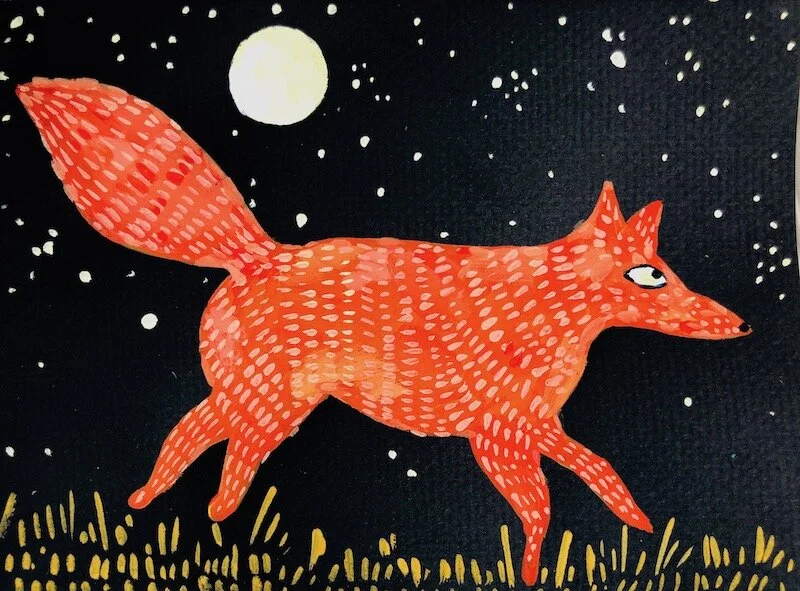
Artwork by Julia Edith Rigby.
The Herd is a literary newsletter that celebrates artistic expression and elevates artists who build community and foster connection.