On Resting and Change-making

INTENTIONS | 1.3.2021
Dear Herders,
I hope you all have had some time this past December for a little rest and recharge, as well as joy. I also know that many of you might not have had the opportunity to rest, being essential workers, parents, caretakers, independent artists, patients, activists, and more. I wanted to share this reminder, looking at the year ahead, that rest also lets us do the things we love and care most about.
We are not machines. We have soft, supple bodies that need rest. With the resolution-making culture each January, I have to remind myself also to rest here and there. There is a lot to grieve each day and a lot to act on. Rest helps me do both.*

In this issue of The Herd, our amazing artist feature is Aster K. Foley, a queer printmaker, and community builder with a B.A. in Art Studio from UC Davis. You may remember their work from our last issue too, as well as the various ways to support their ongoing artwork, with all proceeds going to their ongoing chemo treatment. Plus their new zine which is currently in the works!
We also have our monthly writing prompt, a lit review of Janet Mock’s second memoir, Surpassing Certainty, and more. Lastly, I’m offering an online poetry workshop called The Poetics of Place, from 10:00 am-12:00 pm PST, on January 23rd. Come write!
With all this said, may you continue to be driven to enact change in little and big ways. May art, words, clay, beads, and combinations of all the above mold themselves into new paradigms of thinking and being. And may you give yourself permission to rest, especially on those days or evenings when you need it most.
Wishing you all a month and year ahead of “rest, act, repeat” vibes. Your work matters. And you matter. Very very much.
-Allie
*Post-publication note: The idea of “resting in order to keep doing the work” is not my idea. Many Black women and people of color have spoken about the need for rest. Tricia Hersey, the founder of The Nap Ministry, shares her insight around the notion of rest-as-resistance, especially for groups of people historically marginalized and oppressed.
CREATIVITY CRUSH | 1.3.21
Aster K. Foley on Printmaking, the Best Way to Cook a Muffin, and Staying Alive.

Aster in the studio making a screen-printed tee.
As you may know from our last issue, Aster K. Foley is a queer printmaker with a B.A. in Art Studio from the University of California, Davis. They grew up in the middle of the woods in New Hampshire, and have spent the last decade as a California transplant. Their work often deals with themes of gender presentation, social dysphoria, and non-binary joy.
Their current zine “I Don’t Know How to Tell You This,” goes towards funding their ongoing chemo treatment. You can Venmo @akfoley, or PayPal for your PDF of this intimate zine. Every little bit helps!
Enjoy the interview below, check out how to join their Art Club for queer creators, and if you are able, support Aster’s ongoing and badass work!
The Herd: Can you tell us a little bit about your personal process of making art? Were you always drawing and creating art, and if not, what drew you to it?
Aster K. Foley: My personal art practice doesn’t follow the “draw every day” model of art-making. All respect to artists who can maintain that, but it’s never worked for me. My inspiration, amount of physical energy, the stress of my day job, and mental health state tends to ebb and flow, and I let myself follow that.
I grew up drawing, but the artform I really love is printmaking. I love the physicality of screen printing and relief printing, the communal spirit of a print shop, getting to work with and take care of big machines, and being able to offer handmade art at a more accessible price than one-of-a-kind work. Not having access to my usual workspace during the pandemic has been strange, but I’m trying to embrace exploring other mediums.
The Herd: Your digital zine "I Don't Know How to Tell You This" is personal and intimate. Do you find this process of sharing your diagnosis revealing in a way that feels therapeutic, or is it painfully vulnerable, or neither?

“I Don’t Know How to Tell You This,” a zine by Aster K. Foley, made during the process of being diagnosed with cancer this May. Venmo @akfoley or
PayPal.me/easternfolly for your PDF - all proceeds go towards their current chemo treatment. Any support and sharing is greatly appreciated!
Aster K. Foley: Creating and releasing “i don’t know how to tell you this” has been more therapeutic than painful. Navigating the medical landscape as a cancer patient has been unavoidably vulnerable — for example, I’ve broken down crying in front of doctors, and had more than one nurse examine my butthole — but making this zine helped me process my experiences.
You don’t get a cancer diagnosis overnight; there’s a lot of mystery pain, dread, tests, and endless copays before anyone can figure out what’s wrong with you. During all of these doctor’s appointments, I was alone and terrified (due to COVID restrictions, I wasn’t allowed to bring anyone into the hospital with me). Writing the zine on my phone was a way for me to stay grounded. Releasing it also helped me make money during a time when I can’t work, and still need to support my landlord through this pandemic.
The Herd: Can you tell us a little bit about your upcoming Chapbook, which I believe has to do with your changing relationship to food while surviving cancer?
Aster K. Foley: “Before It Gets Better” did start that way! I started this project in back in July, and it has broadened in scope since then. This new zine touches on food and how I couldn’t eat for a month, my trips to the ER, the losses I’m grieving, how it feels to be immunocompromised during COVID, and the best way I know of to cook a muffin. Some of my closest friends were kind enough to contribute artwork. Keeping me alive has become a communal effort, and I felt like this project should reflect that.

Click on the image above or here to learn more and purchase Aster’s next zine!
The zine will be available as a downloadable PDF here by the end of January. I’ll also post updates to my Twitter and Instagram as the release date solidifies.
The Herd: Are there any other artists whose work you'd like to give a shout-out to right now?
Mara Gervais is a fellow printmaker and zine-maker. They inspired me to start making zines! I particularly loved (and cried over) their risograph zine “Not Non-Binary Queer Brown Enough” about feeling like an outsider within their own communities.
Julia Edith Rigby is constantly diving into new mediums, but always manages to make lyrical work. She works with natural elements like willow and driftwood to make gorgeous sculptures, and seems equally at home out in the woods or welding in the shop.
I’d also love to shout out Zeina Baltagi’s recent lecture series with 11:11—A Creative Collective. In November, she led a series of discussions on the intersections of surveillance with topics like race, governmental profiling, self-policing, social media and reality tv. The standout one for me was between Zeina, Lechedivirgen Trimegisto, and Ted Meyer on their experiences with medical surveillance. You can find the recordings of these discussions on 11:11—ACC’s YouTube channel.
The Herd: Any other questions/comments/topics you'd like to share or use this space for?
Aster K. Foley: Pre-COVID, I hosted a meetup group called ART CLUB for queer creators who live in the greater Sacramento area. We’ve moved online until it’s safe to meet in person again. If you’re a creative queer person in need of a kind, encouraging art community check us out on Instagram at @queerartclub or reach out to me directly @easternfolly on Instagram or Twitter.

You can explore more of Aster’s incredible prints, zines, and more here.
JANUARY WRITING PROMPT | 1.3.2021

Morgan Parker’s poem Welcome to the Jungle, published in 2016 by Prelude, flows in an exploration of identity and home. Images of home flicker, from snippets of partying, to being alone in a room, to being away from home and missing it.
Read Morgan Parker’s poem aloud at least once and pay attention to the line breaks and run-on sentences. Then, play with line-breaks during a 10-15 free-write. Without judging the content of your work, try to let sentences run-on with you in a stream-of-consciousness manner, so that your ideas extend beyond the single line.
If you’re really stuck with starting, you can add the additional prompt of starting with the line, “Sometimes the image of a catches me in the mirror.” Don’t think too much or censor yourself here—just write.
Writer’s Tip: I’ve mentioned this before, but try not to judge the content or “quality” of yourself while responding to prompts. Don’t edit as you go along! That can all happen later. Set a timer, and try to write without stopping.
QUICK LIT REVIEW | 1.3.2021
Janet Mock’s Second Memoir Dedicated to Lessons from Her Twenties
Surpassing Certainty is the second memoir by writer and producer Janet Mock, following Redefining Realness. Published in 2017, this memoir invites readers along the rollercoaster of love and work, following Janet Mock’s big move in her early twenties from where she largely grew up in Hawaii (after moving around a lot) to the bright lights of New York City.
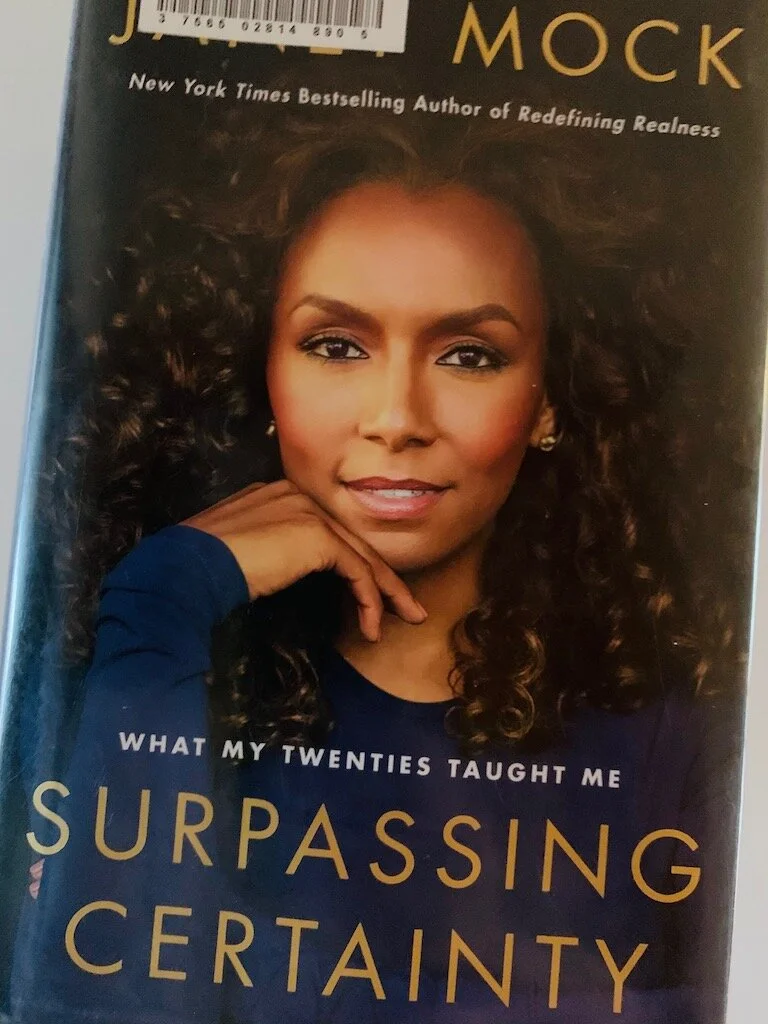
Janet Mock’s books, essays, and interviews can be found here.
Mock’s recent essays can be read here, and her shows like Pose, Hollywood, and Monster are available on Netflix.
Unlike Redefining Realness, which focuses on the loving community of fellow Black trans women who guided Mock in her coming-of-age years, Surpassing Certainty explores Mock’s desire for equitable career growth as well as romantic love. She is unflinching in the detailing of the daily racism she experienced at Time Inc., specifically while working in the editing department for People Magazine.
One of my favorite moments is when Mock details the limitations of contemporary ideas around trans identity, such as the notion of “passing.” She writes how she has, “[…] always taken issue with the term passing. It promotes a false impression that trans women are engaging in a process. through which we are passing ourselves off as cisgender women—which we are not. We are not passing as women. We are not trying or pretending to be women. We are women, and cis people are not more valid, legitimate, or real than trans people. Besides, to pass always felt like an insult when I was trying to excel” (Mock, xix).
In addition to hardships of marriage and romantic love, the themes of friendship also flow throughout this account of Mock’s twenties. She grapples with her need to excel and break the mold for those following her, and also navigates her need for independence while in a marriage that is slowly falling apart.
The twenties are a confusing time of self-discovery, and Janet Mock shares her coming-of-age experience in a way that continues to pave the way, offering what is still a novel idea in the 21st century: trans people can have joy, can define career success on their own terms and succeed, and can be cherished in safe, loving relationships. Mock’s memoir reminds me of how white supremacy and patriarchy can make such dreams seem like fantasies, rather than achievable realities.
HAPPENINGS | 1.3.21
Featured Herder Zeina Baltagi hosted a Discussion series on the body, investigation & surveillance — all five engaging discussions can be watched here.
VIRTUAL: Wall + Response Poetry Reading — January 29th, 6:00 PM PST. From their event page, the “Booksmith and The Bindery present the second of a four-event series presented by Clarion Alley Mural Project (CAMP) called Wall + Response, featuring Karla Brundage, Jennifer Hasegawa, Tureeda Mikell and Kim Shuck responding to the mural We Want Respect, Freedom, Land, Housing, Justice, Peace, Bread by Emory Douglas/Black Panther Party / Remix by CUBA, D8, MACE.” Register for the event here.
Need some new reads? I’ve got a stack of old reads I’m still working through. Regardless, here’s a list of 12 “must-read” books out this January. Click here to explore.
VIRTUAL: The Poetics of Place — Allie Rigby will be offering an online writing workshop on January 23rd, 10:00 AM - 12:00 PM. Thank you to PRSNA Field Institute for making this event possible! You can register or learn more here.
Submit poems to a new interdisciplinary project called (home)Body. You can learn more here. The poems they commission “will seek to represent a multiplicity of voices. They will inform the content we create and will function as scaffolding and inspiration for the dance and video.”
That’s it for Issue XVIII of The Herd. Feel free to comment below, or share The Herd with anyone who needs a lift.

The Herd is a literary newsletter that celebrates artistic expression and elevates artists who build community and foster connection.