Seal Lions in Water
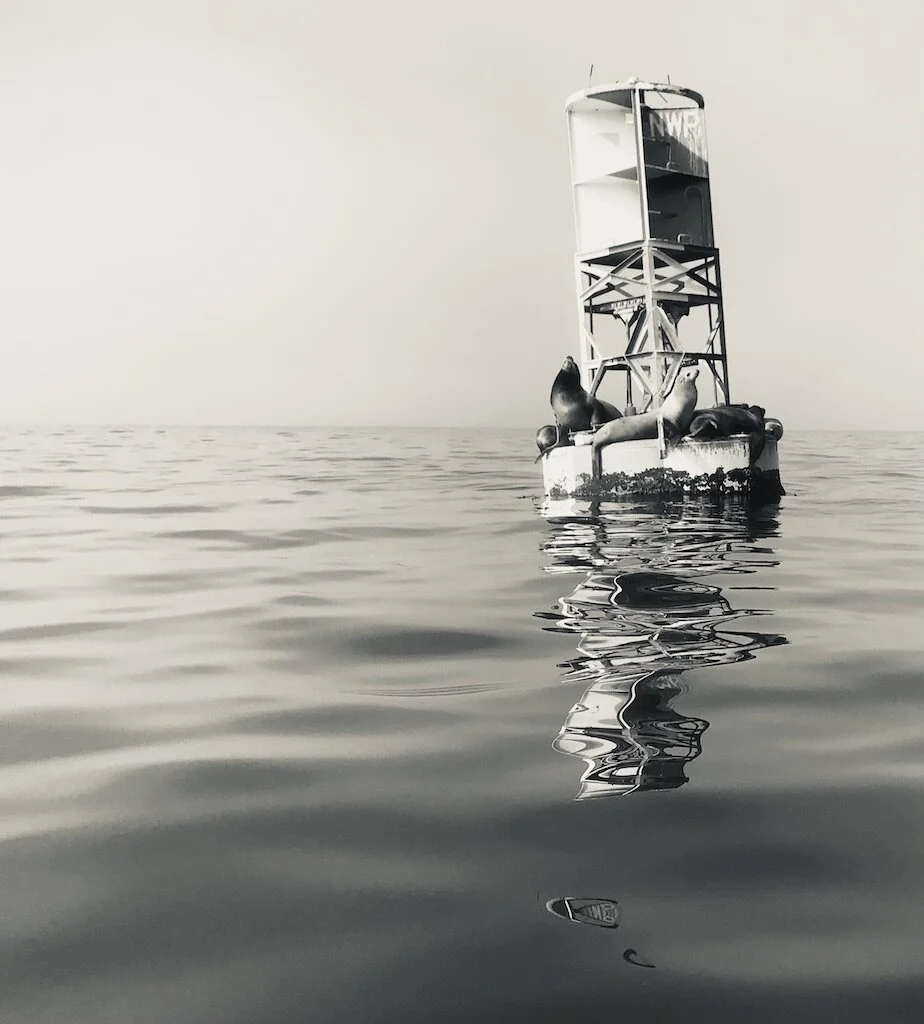
Sea lions at Big Corona Beach, courtesy of @JuliaEdithRigby.
INTENTIONS | 12.1.2020
Dear Herders,

“I Don’t Know How to Tell You This,” a zine by fellow Herder Aster K. Foley, made during the process of being diagnosed with cancer this May. Venmo @akfoley or
PayPal.me/easternfolly for your PDF - all proceeds go towards their current chemo treatment. Any support and sharing is greatly appreciated!
Thank you all who submitted their brave, vulnerable, and fantastic work for the Second Annual Fall Harvest this past November. It has been a delight and special experience to read and see the artwork, stories, and projects you all have to share with each other and the world. We will be offering a NEW celebration of Herders in May 2021, and thank you to Iris Crawford for the idea of two special issues a year! If you have any ideas on the name for that May issue, please let me know.
I also wanted to take time to spotlight Karla Brundage’s nonfiction piece, The Best Time to Kill an Elephant, published in Literary Kitchen recently. Karla also has a virtual book reading for “Our Spirits Carry Our Voices: West Oakland to West Africa Poetry Exchange” this Saturday. Sign up here!
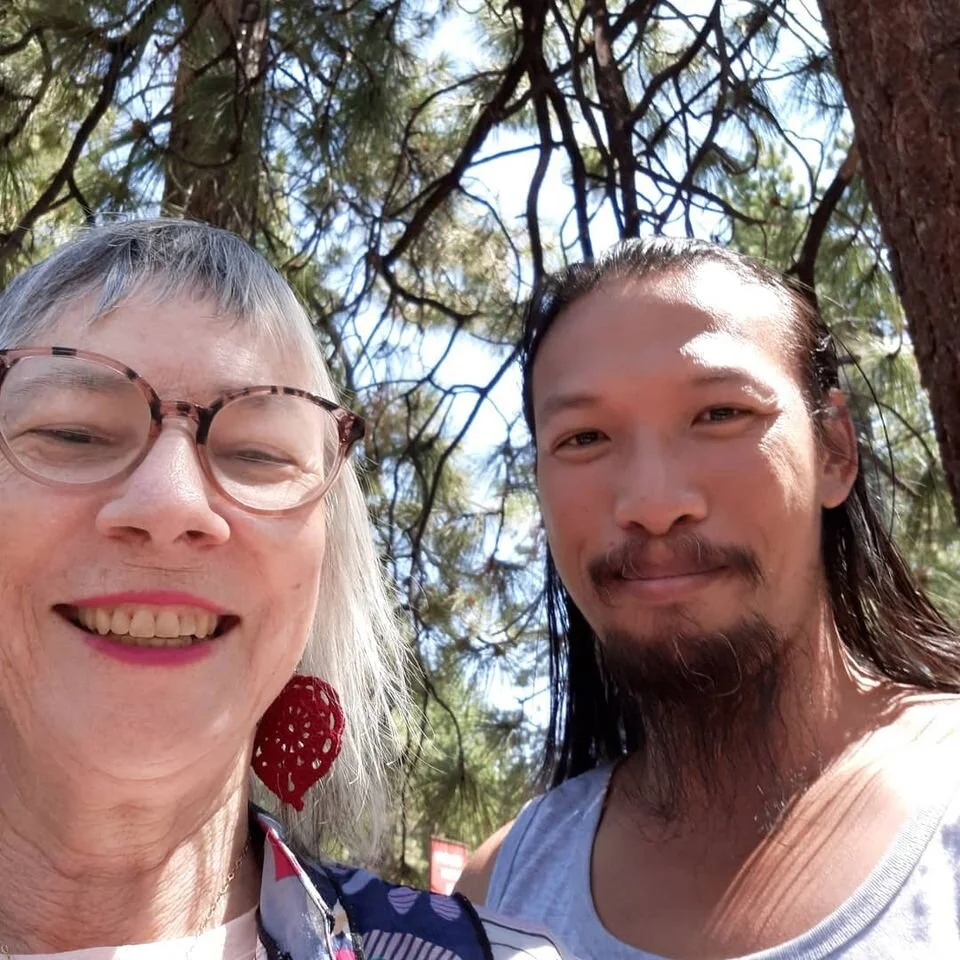
This issue, we have a lot packed in, so take your time and come back often. Our full feature stars the collaborative duo Cindy Rinne and Bory Thach.
I also want to highlight the zines of fellow Herder Aster K. Foley, who is is a queer printmaker with a B.A. in Art Studio from the University of California, Davis. They grew up in the middle of the woods in New Hampshire, and have spent the last decade as a California transplant. Their work often deals in themes of gender presentation, social dysphoria, and non-binary joy. Their current zine “I Don’t Know How to Tell You This,” goes towards funding their ongoing chemo treatment. You can venmo @akfoley, or PayPal for your PDF of this intimate zine. Any support and sharing is greatly appreciated!
P.S. I will be offering a poetry workshop via Zoom on January 23rd. See our Happenings for more details.
CREATIVITY CRUSH | 12.1.20
Performance Poetry and the Collaboration Behind “Letters Under Rock”
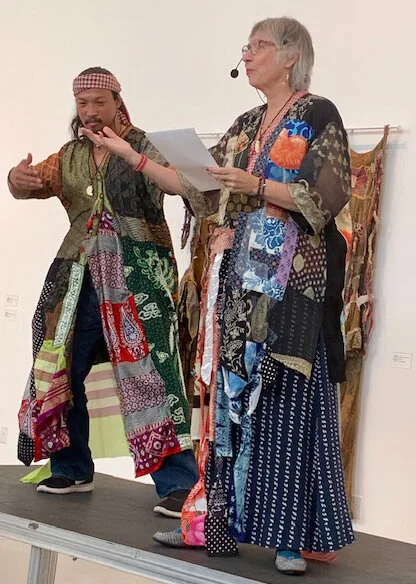
Performance of “Letters Under Rock.” Photo courtesy of Edwin Vasquez.
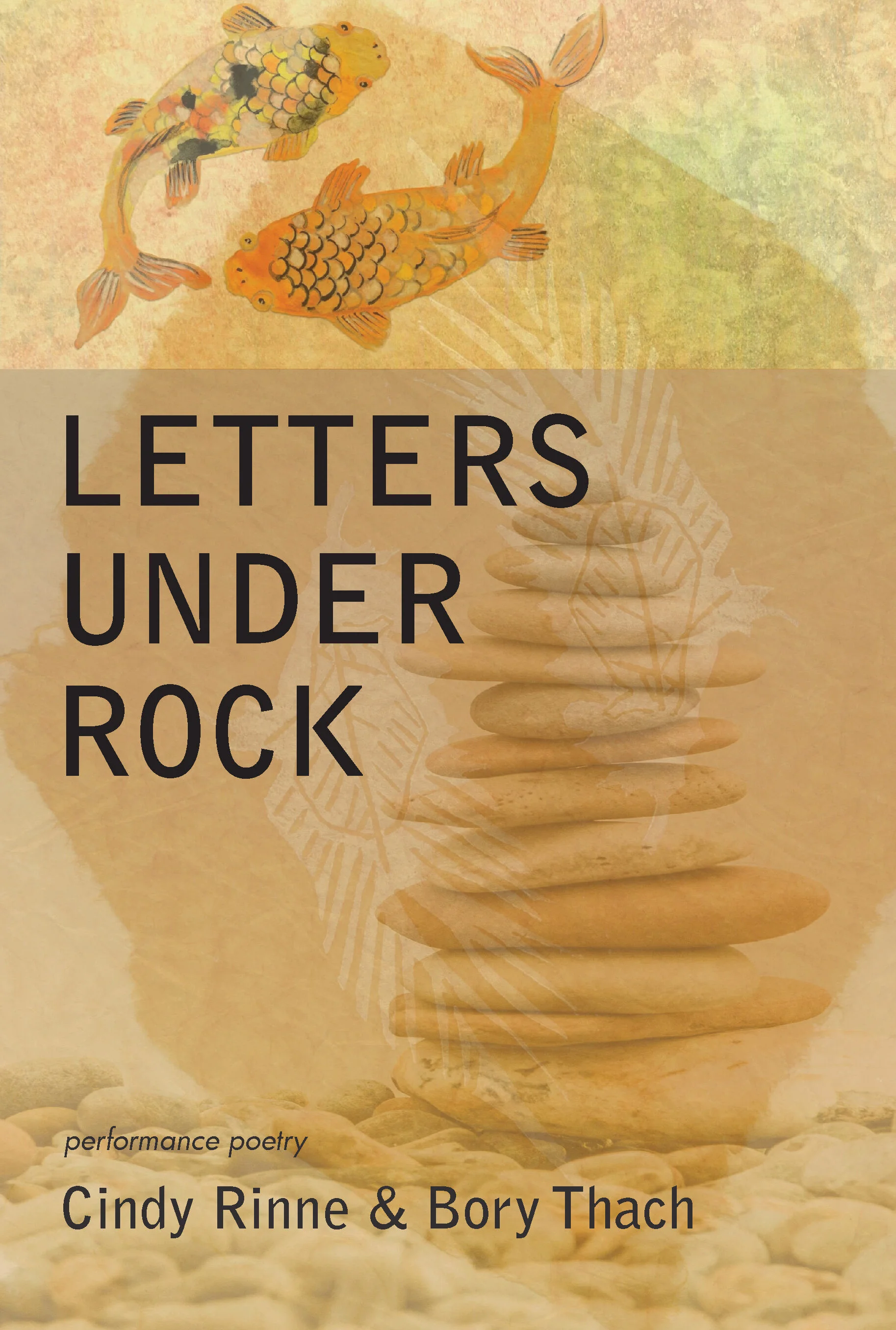
Cindy Rinne and Bory Thach’s written work is meant for the stage—and will return to the stage soon, when safe. Initially, the poetry book Letters Under Rock debuted as a visual performance, complete with the wearing of Cindy’s colorful sculptural costumes, which she made herself.
Rinne and Thach invited the audience to witness a spiritual exchange between two characters: a Wanderer and a Nomad. A few months before their debut performance, Cindy asked Bory to write a poem in response to one of her sculptures for a collaborative exhibit. "I didn't have time to create artwork with another person," Cindy explains.
Bory Thach explains how, after deciding to collaborate together “continued writing back and forth in the form of letters once we saw that there were two distinct characters that made themselves known. For us, the story of the Nomad and Wanderer continues through future performances.”
After their initial exchanges, Rinne and Thach had only two months to write enough letters to make a performance, as well as establish and practice the choreography by the opening reception—which they managed to pull off. “The curator came up with the idea to perform and to wear my sculptural costumes that were a part of my installation,” Cindy explains, and “Bory was open to the idea of performance.”
For more, please enjoy the interview below, stay tuned about their future performances, and order a copy of Letters Under Rock from Elyssar Press.
The Herd: Can you tell us a little bit about your personal process of making art as individuals, as well as together?
Cindy Rinne: I like to collage together myths, life experiences, and my spiritual journey. Prompts inspire sometimes. Reading other poets of many different styles helps to expand my writing. For “Letters” we each have a persona and we wrote in response as we answered each other’s letter.
Bory Thach: I write from a storyteller’s point of view. My background is in fiction and memoir, so I incorporate those tools when writing poetry. I use the language of poets to help me see the stories unfold. Much of what I’m writing comes from cultural traditions that I follow, such as my spiritual beliefs, and lived experiences.
The Herd: How do identity and social politics influence your art, and vise versa, if applicable?
Cindy Rinne: Nature is a big inspiration for my art and writing. Reminding people of it’s importance matters to me. I also enjoy exploring various cultures to find the ancient stories which affect the present. Stories can unite us.
Bory Thach: The idea of personal identity, social or political do influence my work to a degree. But I choose to focus on what makes us similar across cultures, traditions, religious, or spiritual in nature. If the writing is honest and true, then it will speak to people from all backgrounds. It connects us on a subconscious level. It’s all about learning, for me and those who respond to my work.
The Herd: Are there any other artists whose work you'd like to give a shout-out to right now?
Cindy Rinne: So many amazing authors! A few: Eve L. Ewing, Cynthia Anderson, Armine Iknadossian, Sam Roxas-Chua, Natalie J. Graham, Lauren K. Alleyne, Julia Bouwsma, Nicelle Davis.
Bory Thach: Professor James Brown, writers Diana Wagman, and Robin Russin are teachers who I learned a lot from when it comes to creating characters and telling a story.
The Herd: Anything else you'd like to share about that are not asked here?
Cindy Rinne: “Letters Under Rock” is a story about a relationship and their journey. This affects the poems, the tone of the work, the performance, and the future story.
Bory Thach: I hope those who are interested in “Letters Under Rock” approach it with openness and intrigue. Art itself needs to be shared and interpreted individually. Everyone will come away with a different understanding.
The Herd: Will there be future performances and collaborations, post-Covid?
Long answer short: We LOVE performing the poetry and yes, we will again!
Cindy Rinne is a poet and fiber artist based in San Bernardino, California. She’d like to give some gratitude and shout-outs to a new art publication started during the pandemic called Fish and Zoom, as well as the publication “Agri-Culture” Artillery Magazine, and Elyssar Press who published their book. She also has a solo exhibition called “Magical Realms,” which opens on January 2, 2021 and feature’s Rinne’s fiber art and sculptures at Bunny Gunner Gallery in Claremont, CA. One of her essays is also in the new anthology Feminist Pilgrimage. You can visit her website at www.fiberverse.com.
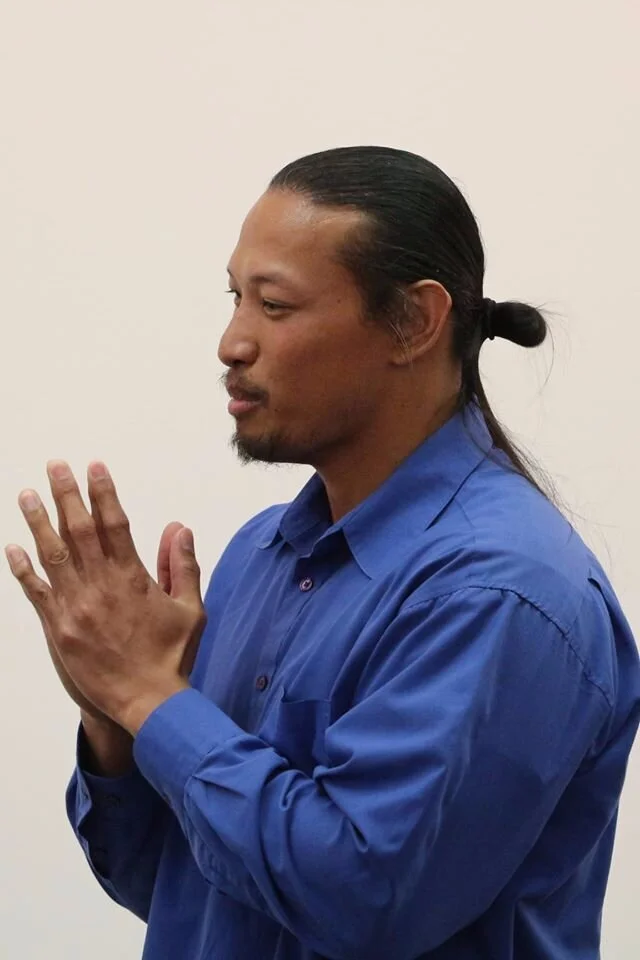
Bory Thach was born in a refugee camp located on the border between Thailand and Cambodia. His family immigrated to the United States when he was four years old. He served in the U.S. Army and deployed to Iraq in support of Operation Iraqi Freedom. He received his MFA from California State University San Bernardino. Fiction and creative nonfiction fall under the art of storytelling, while poetry for him is more of a study of language, an art form in itself. His work has been published in Pacific Review, Urban Ivy, Arteidolia, and Sand Canyon Review, as well as Letters Under Rock.
Note: Together, Cindy Rinne and Thach are also both published in We Are Here: Village Poets Anthology by Moonrise Press, edited by Maja Trochimczyk and Marlene Hitt. "Halo" (poem above) was first published by Cloud Women's Quarterly.
DECEMBER WRITING PROMPT | 12.1.2020

Esmé Weijun Wang is a writer with detail in her left hand and nuance in her right. I return to her work a lot. In a recent workshop, Wang discusses how she doesn’t necessarily subscribe to the belief that writers need to know their own “moral of the story” for any of their works. For many of her own essays, she is more interested in making people ask more questions—about everything.
For this prompt, think of a specific place that potentially has some angst to it, where you had multiple kinds of epiphanies and introductions, of sorts. Create a list of all these things, and/or “lessons learned” at this place. Start the prompt with the words, “(Name of place) introduced me to )” and please give credit to the prompt source, as I gleaned this idea from Wang’s The Collected Schizophrenias: Essays (Graywolf Press, 2019).
For example, Wang writes with incredible detail how “Yale introduced me to swooning over course descriptions in the Blue Book; “shopping period”; my being openly queer; life without my family, whom I avoided calling for months; WASPs; the attitudes and postures of Old Money; goat cheese; people who bought six-hundred-dollar-boots; the understanding that six-hundred-dollar-boots existed; legacy students who’d known the fight songs since birth; Gothic architecture; Beinecke Plaza; Audiogalaxy; theory; statistical analysis (…)” (Wang 63).
Writer’s Tip: Making lists can be a great way to loosen the brain’s memories and get writing. I like in the excerpt above, how Esmé, mixes up describing objects like the course book, with more tender emotional references like “life without my family.”
QUICK LIT REVIEW | 12.1.2020
We HAVE Been Too Patient: Green and Ubozoh’s Mental Health Anthology Delivers
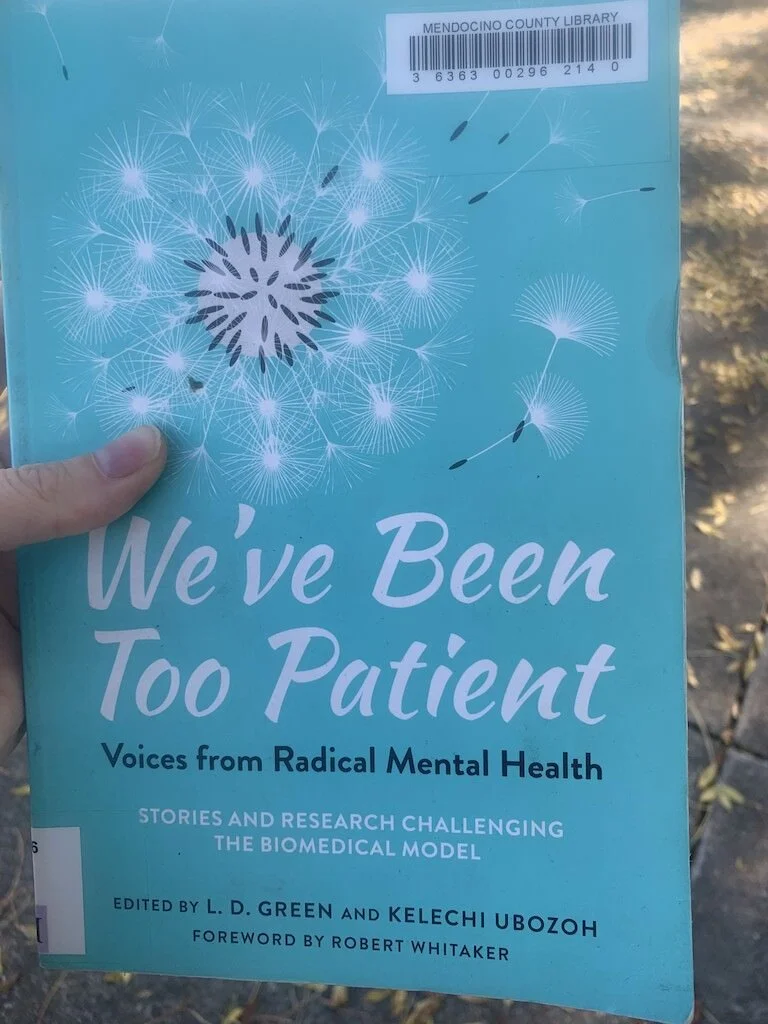
A little shout-out to the local library scene and its volunteers right now, making “curbside pickup” a safe and smooth process so folks can still have their book friends. <3
The “vision and passion for this book has been a process that mirrors its produce. We are both wounded healers and mental health advocates with lived experience” (Green and Ubozoh 5).
This collection of essays aims to challenge “the biomedical model” that prescribes those struggling with mental health as problems to be fixed (ie. “illness-based treatments”), rather than as people with their own insight to what they might need to heal. The two editors are superstar mental health advocates, L.D. Green and Kelechi Ubozoh. Their collection here offers multiple and varied testimonies that express the need for “radical healing” that honors people’s “lived experiences” with mental health.
It’s an important book that has completely cracked open my own understandings of mental health—at a personal and societal level—while also expanding my preconceived notions of how and why the biomedical model needs to change.
10 HAPPENINGS | 12.1.20
VIRTUAL: Berkeley Lunch Poems with poet Yosef Komunyakaa. December 3rd, 12:00 PM PST. Komunyakaa has published over 11 books of poetry, as well as received the Pulitzer Prize for his work Neon Vernacular.
Shopping for the holidays? Did you know that indie bookstores make like a third of their sales between Thanksgiving & New Year's? You can find and support a Black-owned bookstore here!
VIRTUAL: West Oakland to West Africa Poetry Reading. Join “Poets from the book Our Spirits Carry Our Voices: West Oakland to West Africa Poetry Exchange” in a virtual book reading on Saturday, December 5 at 1:00 PM PST.
Featured Herder Zeina Baltagi hosted a Discussion series on the body, investigation & surveillance — all five engaging discussions can be watched here.
PEN America recently awarded Xu Zhiyong the 2020 PEN/Barbey Freedom to Write Award. Xu is now being detained indefinitely. Please sign this petition for his release.
Saad Bee Hózhǫ́, a collective for Diné writers, held a poetry reading in June—the fundraiser remains open for White Mountain Apache Tribe Covid-19 Relief Fund and Navajo & Hopi Families Covid-19 Relief Fund.
VIRTUAL: In Honor of Audrey Lorde and and Pat Parker. Six writers and artists gathered last month “in honor of the work, spirit, and continuing influence of these two Black lesbian friends, dedicated movement workers, and outstanding, outspoken poets.” The link above is the recorded event.
PEN America’s Virtual Gala is December 8th. RSVP here for free or consider donating to their cause. The PEN America Gala will merge their “annual New York Literary Gala and Los Angeles LitFest Gala.”
The Poetics of Place — Allie Rigby will be offering an online writing workshop on January 23rd, 10:00 AM - 12:00 PM. Thank you to PRSNA Field Institute for making this event possible! You can register or learn more here.
Writing personal nonfiction about painful topics? Writer and poet Elisa Gabbert offers “five paths” in her Ethical Advice for Writing About Friends and Family.
That’s it for Issue XVII of The Herd. Feel free to comment below, or share The Herd with anyone who needs a lift.
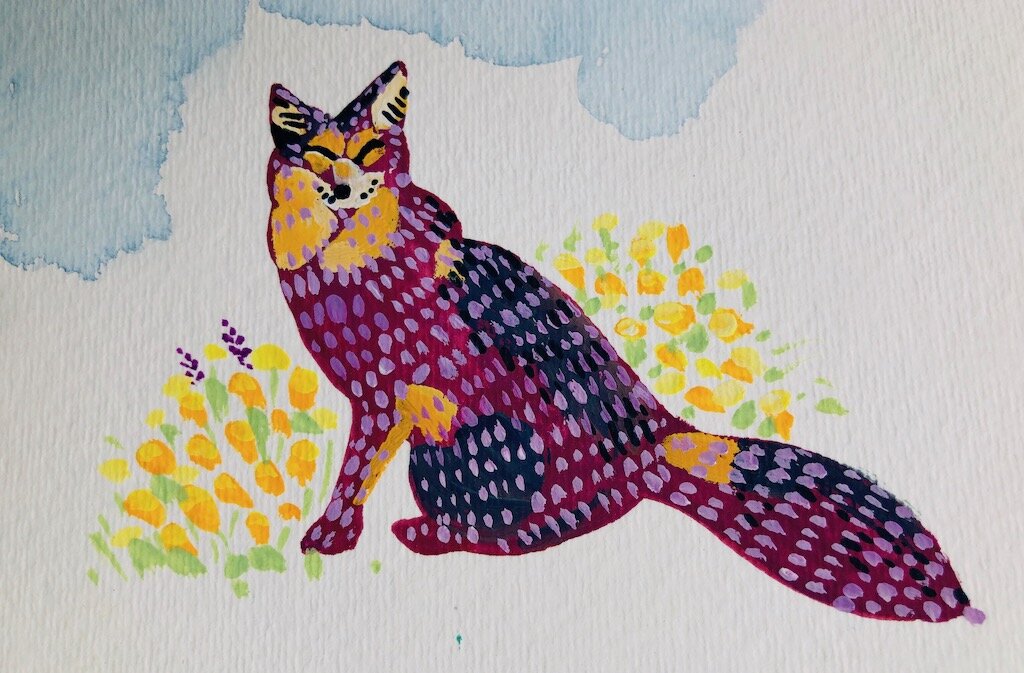
Artwork by Julia Edith Rigby.
The Herd is a literary newsletter that celebrates artistic expression and elevates artists who build community and foster connection.