Winter Reads

INTENTIONS | 12.7.2021
Dear Herders,
I’ll keep this short and sweet—you don’t want to miss a thing in this issue!! Thank you so much to Karla Brundage and Allison Francis for their fabulous interview and double feature in The Herd. Their interview below explores how poetry can defy stereotypes and build new, better worlds. If you order their new book, Mulatta—Not So Tragic? you are also supporting an indie press!
More so, thank you to our literature reviewer Kelly Alsup for her insight around Bonfire Opera, a collection of poetry by Lanusha Laméris.
And thank YOU, readers of The Herd!! Fellow artists, printers, teachers, students, parents, scientists, journalists, ceramicists, family, and friends. Thank you.
Prompts, happenings, and more—yours for the reflecting. May we close this year and honor those we love and those we have lost. May we never stop loving them. May we hold ourselves gently.
Your writer friend,
Allie
FEATURED ARTISTS | 12.7.21
Poets Allison E. Francis and Karla Brundage Reclaim a Stereotype with their NEW BOOK, Mulatta—Not so Tragic?
What’s not to love in a book that explores friendship, race, and gender while also dismantling a harmful stereotype? Collaborative duo Dr. Allison E. Francis and Karla Brundage offer a dynamic book of renshi poetry—linked poetry—that speaks to Black Girl Friendship, to the healing found in nature, and to the declarative power of words.
Enjoy this lengthy interview and take your time with it; it’s one you will want to return to, again and again. There are also links to their book throughout the interview. Be sure to check it out and reserve your copy!

Allison E. Francis (left) and Karla Brundage (right) collaborated on a new book of poems that explore gender, racism, and Black Girl Friendship. Purchase their new book here!
The Herd: You both just released a new book Mulatta—Not So Tragic? where you both explore and question the “tragic mulatta” stereotype, as well as engage with ideas around friendship, race, and gender. Can it be said that the title, as well as this entire exchange, is a reclamation of the word “mulatta?”
KARLA: I am not sure if it is a reclamation of the word as much as it is a reclamation of the stereotype of the tragic mulatta. For me, this is not a bad word. I find the word mulatta or mulatto to be a really beautiful sounding word, as far as words go. I like it better than mixed, half breed or even bi-racial. However this idea of being tragic or of being a victim, that is what I would like to dispute.
ALLISON: I agree with Karla that one of our endeavors with the collaboration is to revisit and perhaps rethink the stereotypes associated with the tragic mulatta trope. Richard Wright taught us that words are powerful when we give them power, so why don’t we empower words in an enlightened fashion rather than write them out of existence?
The Herd: In terms of process, how did you both go about this exchange? Is your writing process different when writing renshi poetry?
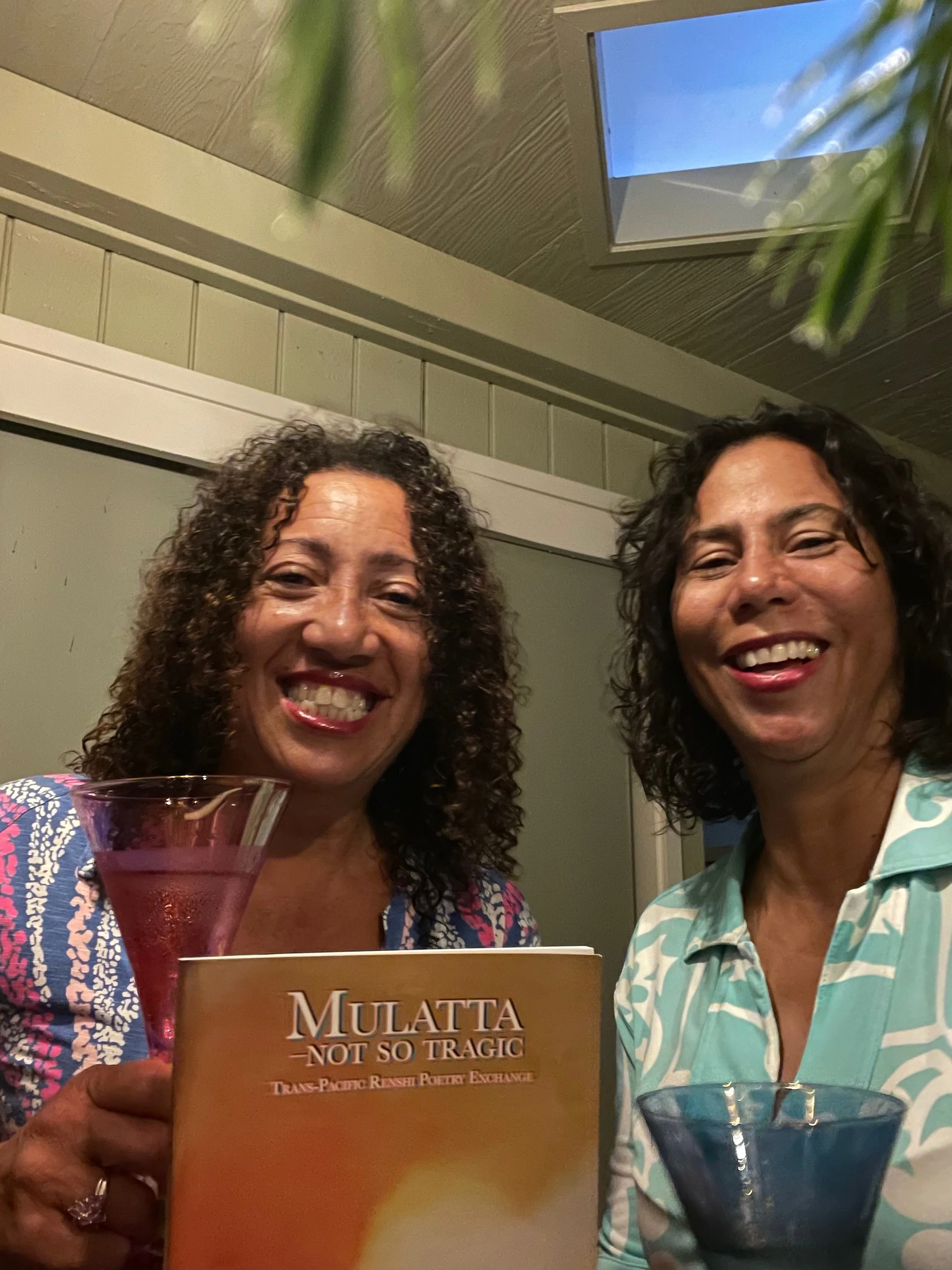
Allison E. Francis and Karla Brundage celebrate the release of their latest book, Mulatta—Not So Tragic? from Fleur Du Mal Press. Reserve your copy today!
KARLA: This process I believe was brought to my attention attention by Allison one day when at the Blow Hole, also known as the “From Here to Eternity” beach. It is a beautiful place on the stark side of the island where the blackness of the lava and the white sand combine with the ocean to make the most stunning colors of blue you’ve ever seen.
Allison and I often go to that beach, her favorite, and I loved that side of town because I used to go body surfing with my dad there at Makapuu, the next beach over around the other side of the lighthouse. Anyways, I digress.
As Allison and I were sunbathing one day, she said, I heard of this form of renshi. I don't know, I could have said it, I really don't remember, but I think she said it. I might have also heard about it from my other friend Micheline at Bamboo Ridge, but we decided to do an exchange.
I think I sent the first poem, because I was in love at the time and writing a lot of poems, and she responded and that is how it started. I do not think the process is really different except that we respond to each other so a line from Allison’s poem could inspire me to think about things differently. Also the mood or tone of the poem I am responding to could influence the tone I take.
ALLISON: Oh, the Blowhole is my sacred space where healing and magic happen! In fact, I think some of our best ideas occur when Karla and I are either at the beach, or in the ocean. So, the year Karla and I began to share poems in an organized method through emails and phone calls, I had just been introduced to a writing group of women on Oahu who were involved in the renshi process. I had not encountered this type of communal poetry-writing before, so I was captivated by both the beauty of the poems that the group shared, and their unrelenting regard for each other’s process.
So yes, it was me, Karla, but I’m certain you were hearing about renshi poems from multiple quarters.
The Herd: Karla, were there any turns or surprises that Allison’s poems had on you?
KARLA: There was a time when we were in different phases, I think I was going through a breakup and she was getting married. I think sometimes I would send a sad poem that would be met with an upbeat one, or at least that's what I perceived. That could be surprising but I also understood that we were in different phases.

“Usually, those poems I felt less confident about ended up being the ones Karla loved. How gorgeous is that?”
The Herd: How about you, Allison?
ALLISON: At first, your poems feel like you just birthed a child, so as a new mother, you might be a bit hesitant to share that foundling with someone else too soon.
Consequently, there were times when I was unwilling to share a new poem immediately, but then I realised this is a communal process that is safe, protective and nurturing. Go ahead and send the baby, Allison; she will be well-cared for. And other times, I would send Karla a poem, and think “What a piece of crap? Why did I share that with her without revising?”
Usually, those poems I felt less confident about ended up being the ones Karla loved. How gorgeous is that?
THE HERD: Karla, what was it like writing a poem in memory of Zora Neale Hurston and Lorraine Hansbury, a poem honoring two women whose literature challenged so many stereotypes about biracial and multiracial womanhood?
KARLA: One thing I love about writing with Allison is her elevated tone and allusions to Historical Figures. Her poem inspired me to think about Black women writers who had inspired me and who had unique ways of thinking about womanhood or race. In particular I was thinking about Hurston’s famous essay “How it feels to be colored me…” where she explores her coming to her own awareness of her blackness but also her your pre-racial mind, before she felt the pressure of always seeing herself as Black before being a human. Lorraine Hansberry’s autobiography speaks to me as well as she wrestles with what it means to be successful as a Black woman in “To be Young Gifted and Black.”
ALLISON: I absolutely adore Zora Neale Hurston and admire Lorraine Hansberry, so I was more than ready to honour these two giantesses in American literature through the poetic form. More importantly, the struggles they experienced as talented Black women who were striving to be accepted as writers first and foremost, still speaks to these issues extant today wherein we conflate gender and ethnicity with talent. So, are Karla and I Black female poets, are we American poets, or are we poets?

“In the creation of the book, Allison and I discovered that we had been exchanging poems long before this exchange and we found our first poem we wrote to each other.”
The Herd: In renshi, or linked poetry, it seems important to be open with the direction a poetic conversation may unfold. Do either of you find this to be true? Is there an aspect of “letting go” of total control (or artistic illusions of control) in this creative process?
KARLA: I agree that this is true, for me the letting go also came with letting go of how my poems would be received.
ALLISON: Earlier Karla remarked on how she might send me a “sad” poem, that I might respond to with an upbeat. And occasionally, the inverse occurred too. So yes, renshi poetry is a structure that allows for freedom of movement within its parameters, and that freedom sometimes lends itself to extraordinary surprises of pure genius.
The Herd: Karla wrote on her Shuffle profile for this book how, “In this time of Black Girl Magic, a book about Black Girl Friendship seems essential.” Would you describe this collective exchange as a larger love poem, and one that honors the deep healing and strength that can be found in friendship, and in particular, Black Girl Friendship?
KARLA: In the creation of this book, Allison and I discovered that we had been exchanging poems long before this exchange and we found our first poem we wrote to each other. They were not in the renshi form, but were written when we lived across from each other on Harrison street in Oakland. At that time we were both aspiring writers and teachers. We worked together at Fred Finch Youth Center where we met, and we were active in the hip hop and poetry communities. Our friendship solidified in a choreopoem we were both in called “When you think of me…”

Dr. Allison E. Francis and Karla Brundage are two incredible scholars, poets, and collaborative artists. Their latest book is available here!
ALLISON: Right? This poetic conversation between us has been occurring for decades, but because this dialogue has become part of our blood, part of our mutual affection and regard for each other, we didn’t think about it. I cannot imagine a time in my life when I’m not sharing, or about to share a poem with Karla. And sometimes, a simple email exchange shifts into a poetic shout of either rage or celebration, depending on what is happening in our lives. How can I live without this highly expressive form of communication? Well, I can’t.
~
A heartfelt thank you to this incredible collaborative duo. For more ways to connect, follow Allison Francis @allypoetess on Instagram and Karla Brundage @francesca5collina. Check out their websites, linked below, and order your copy of Mulatta—Not So Tragic? today!
Dr. Allison E. Francis, a Professor of English, and Coordinator of the English Department at Chaminade University of Honolulu in Hawaii, teaches and publishes scholarship on a range of topics, which include Victorian Literature, Scottish Literature, Theatre and Poetry,19th Century African American and Caribbean Women’s Literature, Vodou in Haiti, and Women’s Literature, with a focus on science fiction and fantasy. Her poetry has been anthologized in African American Wisdom, and most recently, in Bamboo Ridge Press’s Kīpuka: Finding Refuge in Times of Change, released in October 2021. Allison is also an actor, director, playwright, and a performance poet. She archived a short play on The Breath Project 2020, and Youtube.com, that commemorates the death of George Floyd: Chocolate Cake (8:46). Recently, Allison published a volume of collaborative, renshi poetry, Mulatta—Not So Tragic (2021), with Oakland-based, poet-activist Karla Brundage.
Karla Brundage is a Bay Area based poet, activist, and educator with a passion for social justice. Born in Berkeley, California, Karla spent most of her childhood in Hawaii where she developed a deep love of nature. She is the founder of West Oakland to West Africa Poetry Exchange (WO2WA), which has facilitated cross-cultural exchange between Oakland and West African poets. Karla is a board member of the Before Columbus Foundation, which provides recognition and a wider audience for the wealth of cultural and ethnic diversity that constitutes American writing. Her editorial experience includes a pan-Africanist WO2WA poetry collection, Our Spirits Carry Our Voices, published by Pacific Raven Press in 2020; Oakland Out Loud (2007); and Words Upon the Waters (2006) both by Jukebox Press. Her poetry book, Swallowing Watermelons, was published by Ishmael Reed Publishing Company in 2006. Her poetry, short stories and essays have been widely anthologized and can be found in Hip Mama, Literary Kitchen, Lotus Press, Bamboo Ridge Press, Vibe and Konch Literary Magazine. She holds an MA in Education from San Francisco State University and an MFA from Mills College.


QUICK LIT REVIEW | 12.7.2021
by Kelly Alsup
Danusha Laméris’ Northern California Book Award-winning Bonfire Opera, from University of Pittsburgh Press in 2020, shines like amber agate in sunlight and glows with rapt joy in tandem with signposts of tragedy. In this collection of poems, Laméris chronicles delectably sensuous love affairs, reveals heart-breaking death and loss, and brings levity and light to infinite impermanence.
She does so with acute and earthly language generous and tactile as a garden’s fall bounty, such as in the poem, “Egg,” about ongoing ovulation in middle age, where she notes
“…specks of yolk,
sealed in the same skin,
spores caught in their pinules
beneath the fern’s curled fronds,
barnacles on the back of the whale,
nuggets of ore covered in silt” (68).

Bonfire Opera by Danusha Laméris.
Laméris’ ecology of language—as in, how grounded the work and how at home Laméris is therein—expresses in the facile references she makes to biology and food, mycology and sea life, forest and ocean, mining and geology all within six short lines. And in “Rites of Winter,” her capacity to translate sublimity into terrain and back again manifests through amphibians, as when the power of communion with nature and the throng of dance is
“…one marvelous body, in our smooth
and slippery skin. Even if the frogs did not want us.
Even if our joint fates are written, already,
in the tainted water, the dark and opulent mud” (19).
While this ending forebodes, I see Laméris pointing to the sublime nonetheless through her vision of monumental shifts in the story of existence, all while maintaining a life that feels this planet and the body given to experience it, moment by transitory moment.
I highly recommend this acclaimed book of poetry by Danusha Laméris. After reading, the reader or writer might feel as capable as the work’s title character, the opera singer belting notes at the seashore—able to sustain what is gifted from a deep and rather immaterial place by putting nose to the page, pedal of mind to metal of focus, and of course one’s hands in the dirt of language.
How else does the grape fill the cup?
—Kelly Alsup is a poet, lyricist, and garden educator whose book of poems when if ever alive is available from Finishing Line Press.

DECEMBER WRITING PROMPT | 12.6.2021
Prompt: Continue with this simple opening line, “Trees in winter look like .” Free write, 15 minutes. Try to keep your pen moving on the page and don’t overthink the first image that you feel like declaring trees look like.
Pro-tip: Worth repeating because our “editing brain” can use the reminder. Or at least mine can. Try not to edit as you write… just respond to the prompt first, on a timer. Then go back and edit your work, if you like.
HAPPENINGS | 12.7.21
Previously featured Herder Dorian Katz has NEW art in a comic anthology that will be a “hot, wet, queer erotic comics anthology.” You can back the project here! Yellow is the Warmest Color must be backed by December 26th. Reserve your copy and help them reach their funding goal today!
Every month, a newsletter from Georgina Marie lands in my inbox and makes my day. If you haven’t subscribed yet, it’s a great day to check it out to be in the loop on healing arts circles, poetry podcasts, and more by this wonderful Poet Laureate.
What do prints, zines, and wearable art have in common? Well… have you heard about Dead Penny Press? They are open for custom screenprinting and more. Perfect for unique gifts for yourselves or someone special.
Elyssar Press, founded by Katia Aoun Hage, has a fine selection of unique books, including their latest publication titled Le Leban ou L'Irréductible by Frank Darwiche. #Frenchbookclub, anyone?
Congrats to Julia Rigby finishing her residency at Andersen Ranch!! Her culminating project features chainsaw carving, sculpture, and a disassembly and remodeling of trees.
I’m offering my first six-week workshop with The Loft in Minneapolis! January 25th 2022 through March 1st, centered around Exploring the Possibilities of Poetry. Tuesday nights, come write with us! I am also on Instagram now as Creosote Press and 100% of December letterpress proceeds go to the Dolores Huerta Foundation. I’m offering a new $7 digital download too!
Looking to submit work or apply for grants? Check out the latest publishing houses that are accepting NEW work according to Poets & Writers.
A new Colossus Anthology is in the works, with funds going towards the California Coalition for Women Prisoners. Learn more about submissions and the anthology here!
Herder Tara K. Shepersky and artist Lucy Bellwood released Tell the Turning with the publisher Bored Wolves, who are based in Poland. The result? See for yourself here…
Ya’ll. Don’t be shy—send me your updates and events so I can give you shoutouts and include your happenings in this section. <3 <3



That’s it for Issue XXIII of The Herd. Feel free to comment below, or share The Herd with anyone who needs a creative high-five.
The Herd is a bimonthly literary newsletter that celebrates artistic expression and elevates artists who build community and foster connection.